

How To Draw Animal Characters Eyes , Very Important
It is said that optics are the windows to the soul - and they definitely are a very of import, if non the most important, detail of an animal. This also ways that information technology's important to make them expect skilful.
Now, at that place are a lot of tutorials about how to do this already. However, most are visual and thus can't have thousands of words of text, and most cover eyes only from a certain angle or a certain species. So while I take covered the usual basics here, I've also tried to write about the things you don't commonly hear about.
Unlike types of eyes
First of all we need to await at the different kinds of pupil shapes and centre types, however. There are three mutual ones - (vertical) slit pupils, circular pupils, and horizontal (rectangular) ones. Those cover by far most animals, simply yous will discover some odd ones likewise, like vertical beaded ones, W-shaped ones, or horizontal slits - and others not shown hither.
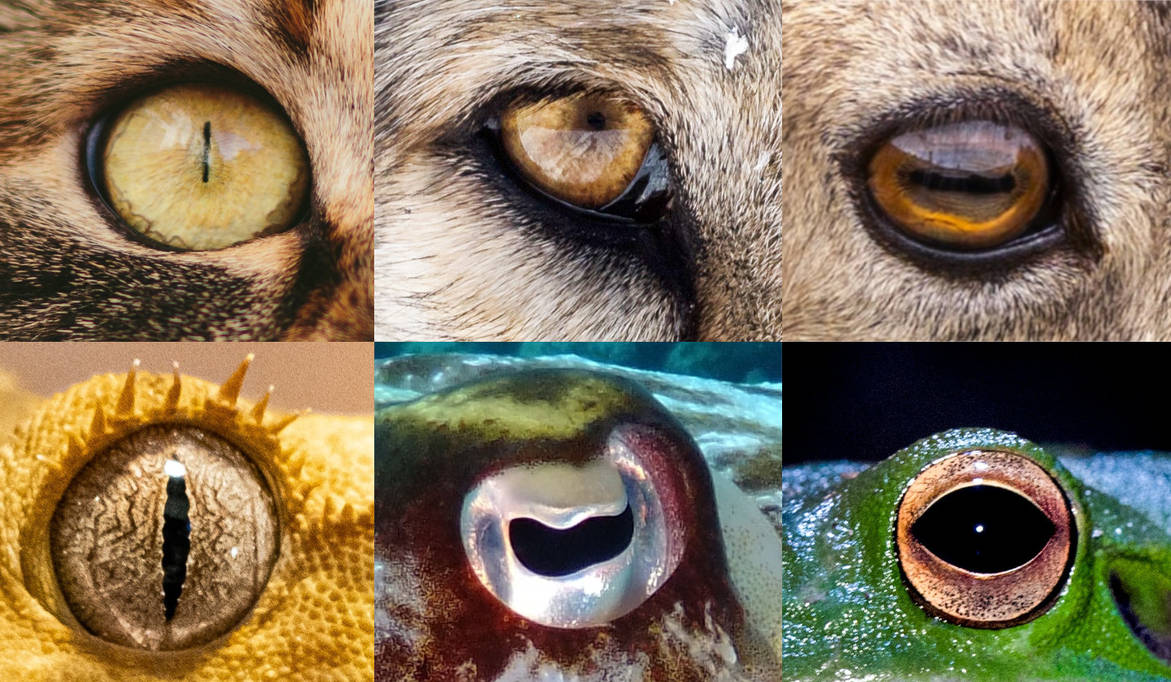
All of those have different advantages, and are thus preferred by different types of animals.
-
(Vertical) slit pupils let for great expansion and are thus good for animals who are active during different light weather condition, including at night. In addition to this they allow the animal to guess short distances well. In general they are preferred by (smaller) predators who hunt close to the ground, like smaller felines, foxes, but too crocodiles and snakes.
-
Round pupils allow for expert depth perception, and are commonly preferred by larger predators who hunt during the day (however, this is not a must, and virtually can hunt at night too - helped by the tapetum lucidum which we'll comprehend later in the commodity). Larger cats and wolves/coyotes/dogs/their closer relatives have circular pupils.
-
Horizontal pupils let for a very wide field of vision - which makes it piece of cake to see anyone who tries to approach, also as keeping an center (pun definitely intended) on the ground. This means they are more often than not preferred by prey animals, similar deer, horses, goats, antelopes, etc. Some smaller predators like mustelids and mongooses also have them. An interesting adaptation to those eyes is that they tin roll around, and thus (almost) always stay horizontal no matter how the animal holds their caput:

-
Vertical beaded pupils are a variant of the usual vertical slit ones, but with multiple pinholes which help the animal to perceive altitude. This is useful, as the critters who accept those eyes - geckos and some species of fish - ordinarily have the optics more than on the sides of the head rather than at the forepart. (More about that in the centre placement section below.)
-
W-shaped pupils are a variant of horizontal pupils which let the low-cal to enter from many directions, which might allow the animal to see contrasts meliorate, as well equally enhancing altitude vision. They are plant in cuttlefish.
-
Horizontal slit pupils are, similar the rectangular slit pupils, common in casualty animals. However, they are most unremarkably seen in reptilians and amphibians.
-
Then there are other uncommon shapes I oasis't covered hither. The xanthous-bellied toad has heart-shaped pupils, hyena pupils are shaped more similar an viii, lynxes accept ovals which are a mix of round and slit pupils...
Concluding affair worth mentioning - changing pupil shape can create some interesting effects. Slit pupils tend to requite a dangerous vibe (draw a equus caballus with true cat optics, and you'll see for yourself), and trying to draw a human with W-shaped pupils... I haven't seen it, merely I imagine information technology to expect weird.
Likewise - be careful about drawing animals with human-like optics. This can work well with a more cartoony style, but information technology can quickly look unnatural or even creepy if you lean towards more than realistic artwork.

...So, just please don't Gollum-ify your cats. Unless yous want them unnerving on purpose.
Heart placement
It is not covered often in tutorials - just getting the placement right is important in order to depict realistic eyes, and thus also realistic animals. This is because the placement determines at which angle we run across the centre.

There are two main placements - at the front end and at the side. Predators unremarkably accept eyes at the forepart, considering this gives a very adept sense of depth. Information technology is, afterward all, important for hunters to know how how far away the casualty is. It is non limited to predators, though - monkeys also take eyes at the forepart, because you lot demand to know how far abroad nearby branches are if you want to leap to them.
Eyes on the front mean those critters don't have a wide vision, though - while the animals with eyes on the sides of the caput do. Having the eyes farther apart means that they tin can see most of the area around them - which is platonic for casualty animals. Spotting an enemy is, after all, more important than knowing exactly how far away they are. This ways that you lot'll usually see them more on prey animals - in fact, they correlate quite well with horizontal pupils - but amphibians and reptiles also have them.
Now, having eyes on the side means you will only run into ane side in forepart view, and the whole eye if you see the animal'southward contour.
Let'due south compare the ii:

Notice how the deer's heart "ends" with the pupil?
(Also, I included the eyelash here. Deer and the like tend to have impressive eyelashes, which are important to include. I'd skip them if you draw crocodiles and the like, though.)
Sideview
Aye, we were already talking near information technology. However, now we're going to look closer to the eye itself, and the anatomy:
Fear not - almost of those terms are useless for our purpose, and there's no need to study those. The important affair hither is the shape. Eyeballs, in dissimilarity to popular belief, aren't completely round. The iris/educatee really are (usually) pretty flat - but has a clear kind of bubble in front of it. This is easily visible when you look at cat or dog eyes from the side - and it'due south of import to remember if y'all desire to get the eye and pupil shape correct.
Even so, I said "normally" - when the beast has optics on the side of the head, things are a piddling bit different. The iris and pupil will be more rounded here - which makes sense, because that style they become an even wider view. This also ways you need to draw those differently than cat/dog eyes, and skip this articulate "bubble" function.
Student sizes
Sticking to anatomy-related bug - notice the muscles in the diagram in a higher place, and how the iris covers part of the lens? This controls the size of the pupil. Smaller pupils will let in less light, while larger ones volition allow in more than light - and the difference can be quite big, especially for animals with split pupils similar the cat:

This means you'll demand to change pupil size depending on the lighting conditions.
Or, rather, think nearly it - there are also other causes for narrowed or dilated pupils, like moods (aroused/aggressive animals tend to have narrow/pocket-sized pupils, defensive or afraid ones might have large ones).
Animals with very large pupils accept a tendency to look cute as well - which definitely is extremely of import and relevant data for anyone who is interested in drawing ambrosial animals.
Tapetum lucidum
Most of united states of america are already familiar with this. If you come across a cat or dog when there'south petty lite, there'south a modify their eyes volition seem to glow yellow or greenish at sure angles. This is because of the tapetum lucidum - a reflective layer behind the retina (so at the back of the eye, see the diagram above), which reflects the lite going in through the educatee. It thus increases the available light in the eye, and allows the animal to see better in the dark. Unsurprisingly, it'southward mutual in animals who are agile in the nighttime - canines, felines, and quite some prey animals (horses, deer, sheep etc.) all have it.
At present, because this low-cal is reflected from the back of the eye, it volition simply make the educatee light up. The light both enters and exits the student, then this makes sense. Information technology's however something a lot of people get wrong - and, admittedly, if you're a certain altitude from the animal or in that location's very little light you lot volition only encounter the glowing educatee but because the residue is subconscious in darkness. If you get close, though, it'southward easy to see.

The tapetum is slightly iridescent, meaning information technology tin change colors depending on the angle y'all see it. Withal, the color too depends on the structure of the heart itself besides - which is the reason reindeer eyes change from a more yellow eyeshine in the summer to a blue i in the wintertime, and why oddeyed animals (animals with heterochromia/two different centre colors) tin have 2 unlike color eyeshine.
The most mutual eyeshine colors are yellow, greenish and bluish, but they tin can as well be white or reddish. The crimson one must non be confused with the red eyes you lot sometimes see on photos of humans. Humans do non take the tapetum, and this red glow is merely the dorsum of your eyeballs beingness lit upwards past the flash.
The white in the eye
Compared to human eyes, animal optics don't tend to take a lot of white. This makes sense, considering the shape of the eyes and how large the pupils tin can get (look at the lower true cat in the "pupil sizes" segment - there's not a lot of infinite for whites there, to say it like that). This does, however, not mean that they don't take them. You merely won't see them that often.

The by far most common occasion to come across those whites is if the animal looks in a management which isn't straight forward - as the lion in a higher place, or the dog in the tapetum lucidum department. This will create a sparse U-shaped light/white shape exterior the iris. Call up that this surface area isn't bright white, and will have shadows and highlights too.
And then you have some animals which are bred to have eyes which... well, don't expect completely direct forward. This is not natural, and commonly a effect of selective breeding - so you won't come across it in the wild. It commonly appears in dogs bred to have huge eyes and which therefore are supposed to be "cute".
Last merely non least, rolling eyes. This is really a variant of the "looking" part, just unusual enough to be worth mentioning. Information technology appears in animals with horizontal pupils, when they look downward, and it is usually seen in stressed or scared animals (makes sense to want to know exactly what happens on the footing shut to you lot so, after all). Yous will besides come across it during the deer oestrus, though, when the stags are high on testosterone.
Keep in mind there is a dark line at the edge of the iris too. This is easier to see when the iris has a lighter color, merely it appears in chocolate-brown eyes too.
Shadows and reflections
Eyes are reflective - and, unsurprisingly, they reflect lighter areas the nigh. The lighter something is, the more light tin be reflected, especially if we're talking about bodily light sources like the sunday, lamps, windows, etc. This is what causes highlights in the eye - and those are very important to include, because they make the eye expect shiny. And we desire shiny eyes.
Annotation that light sources are not the only affair which is reflected - and that the closer y'all get, the more of a reflection you will normally run across. In extreme cases, eyes can work like (convex) mirrors, like on this deer:

It works in this case because of how lite the snow is, and how close the photographer is - information technology'south non exactly something you see that oft. Note that the reflection will be slightly distorted as well, as the eye is convex.
Now, on to the shadows. Shadows are... well, shadows, and are commonly caused by the eyelash/fur in a higher place the eye. If the low-cal comes from the side then the snout can cause shadows as well.
It's important to know that the highlights are created a unlike identify than the shadows, though. The reflections announced on the very outside of the center (recollect the transparent "bubble"?), while the shadows will autumn on the iris and student. This means you can have highlights over the shadows, as on the lynx eye beneath:


This also means the highlights can easily overlap the student. In fact, it can be a skillful idea to describe this, as information technology creates more than depth. Notation that the part which overlaps the pupil might be darker, though.
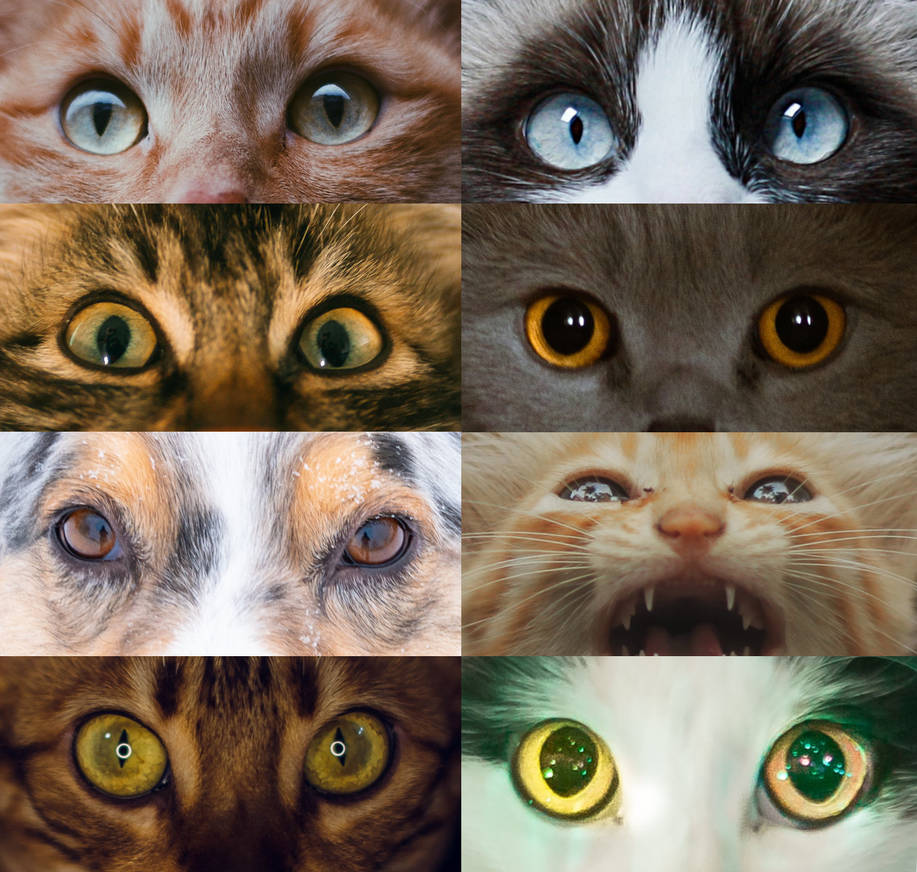
Now, let'southward await at some more or less common types of reflections:
-
Heaven. This happens exterior, and can create large curved highlights. If the sky is bluish, they tend to have a bluish tint.
-
Windows. Those commonly are some course of white/low-cal rectangles or squares.
-
Pinpoints. Commonly when there's a single small (but frequently potent) light source, like the sun or a lamp. Notation that the light comes from below in this image, which means the highlights are at the lesser of the eye too. This is unusual, and can look weird.
-
Multiple pinpoints. Unremarkably happens when there are several lamps, or something obstructs part of a larger one and splits information technology into two.
-
Full-on reflection. In this instance, the dog is looking up at the photographer. This means no shadows, every bit the dog expect directly at the light source - which is merely blocked by the photographer, causing them to expect dark.
-
Some other full-on reflection, where the cat looks up at a window. Notation the square, and the reflection of the scenery outside.
-
If you have weird calorie-free sources, you lot get weird reflections. This cat is photographed while looking at a ring light (used for portrait photography), which causes weird reflections.
-
Last only not least - lots and lots of highlights. Optics with a lot of highlights - something which yous see sometimes in anime fine art, and which gives the characters a "starry heaven" expect - isn't something you usually see, and is therefore almost e'er unrealistic. The exception might exist cats hiding in Christmas trees, as in the instance here.
Eye color
Equally y'all can see from the example images above, eyes come in a lot of colors and variations. At that place are limits to this too, though.
First of all, there tends to be a dark kind of "eyeliner" around the eye. It'southward rarely every bit visible as on the true cat below, but it's still worth remembering. This eyeliner tin can too be night brown or pink, depending on the animal and the coat color.


So you take the eye color itself.
-
Most beast eyes will exist on the brown-golden-yellow-green range.
-
Blue appears very rarely, and usually merely with leucistic (white) animals, and bright blue eyes just appear in domestic animals, like dogs or cats.
-
Red optics are connected to albinism, and are rarely the claret red you might see in artworks or movies (depends on species, though).
-
And, terminal but not least, black eyes don't be. In that location definitely are animals with irises so dark they appear black, merely in the right light y'all'll see they are really a very dark chocolate-brown.
Eyes tin can also have patterns. Wait at the cat in a higher place - there are quite some small darker lines going out from the educatee. Adding those will make the eye wait less flat and more interesting to look at.
At present, how to really draw the eye?

Well, the image already explains most of information technology  And exactly how you draw those eyes will depend on your fashion, medium, etc. So I'k not going to write any long explanations of exactly how to practice this - only what yous need to think about and why.
Note that those are general rules, which work with typical lighting weather. I'd recommend you to look through some of the other images here and study those a fleck.
You will also need quite some different colors - in the image above I can see yellow, orange, crimson orangish, a reddish brown, black, white if yous don't draw on white paper, pink for the "eyeliner"... I can definitely recommend spending your time with cartoon those optics - it tends to pay off.
Closed eyes
Finally, we'll wrap this upwards by talking well-nigh airtight optics. They aren't often covered in tutorials because... well, y'all don't really describe the actual eye. They are yet important to get correct, though.
The most important matter to remember here is that the lines are not straight:

Exactly how this looks will depends on the species, just in that location will at to the lowest degree be 1 angle in in that location, and maybe more.
Too, this line isn't that thin. Practice make it thicker - the fact that the centre is closed doesn't hateful information technology'south barely visible anymore. Retrieve non to overdo this either, though - if y'all're unsure, I'd recommend you lot to look up reference photos online.
Conclusion
...And then, we take 2800+ words about drawing eyes  And not a single pace-by-step affair. I do hope this has still been useful, though, and that you've learned something new which isn't usually covered by the more than standard how-to tutorials.
And with that, I wish you all a good day/night! 

Source: https://www.deviantart.com/beckykidus/art/The-I-hope-complete-guide-to-drawing-animal-eyes-905265382
Posted by: manninosumanducke.blogspot.com
0 Response to "How To Draw Animal Characters Eyes , Very Important"
Post a Comment